From Heritage Port Hope
With the construction of the Grand Trunk Railway, and Port Hope Lindsay and Beaverton Railway in the 1850's, as well as travellers from the numerous lake steamers that visited Port Hope for day trips or en route to another destination, the need for hospitality services increased significantly. By 1857, there were thirteen hotels or inns listed in local business directories, some located on Mill, Walton and Queen Street.
This on-going compilation of Port Hope's early drinking and lodging establishments, their owners and operators, locations, and years of operation, involves considerable speculation due to conflicting claims in various resources.
The page is divided into three sections:
- Section 1 businesses which have occupied the same site over the years and are quite detailed;
- Section 2 those with limited information; and
- Section 3 those with very few details, if any.
Census returns, cemetery records, and land registry records helped provide information, although the workplace locations of the innkeepers weren't always listed and proprietors weren't always the property owners.
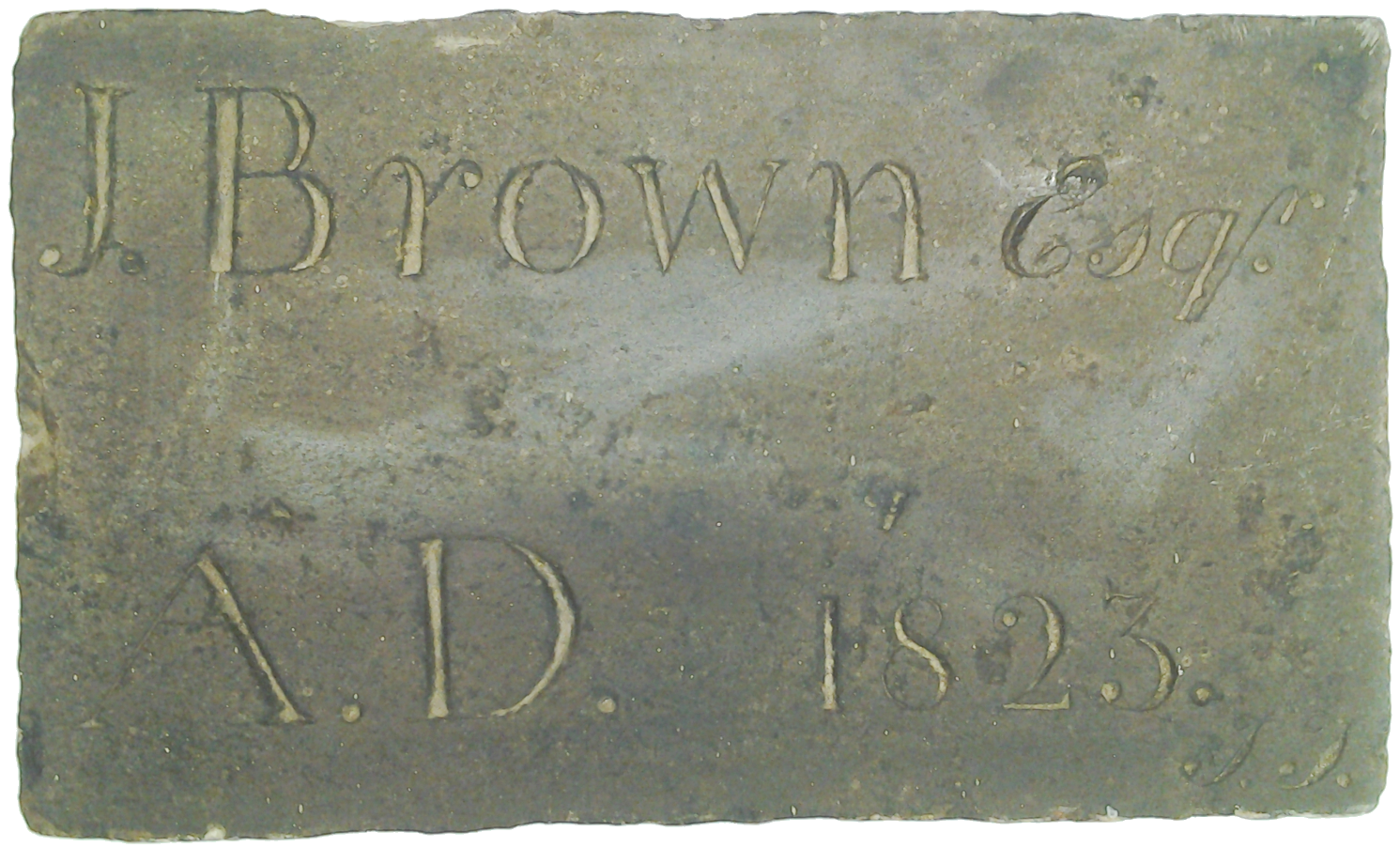
The image above is of the cornerstone, now a part of the Michael Waldyka Collection at the Port Hope Archives, of John Brown’s 1823 home, the first brick building in Port Hope and demolished in 1930. It was home to several hotels, the last of which was the Royal Hotel.
Albion Hotel
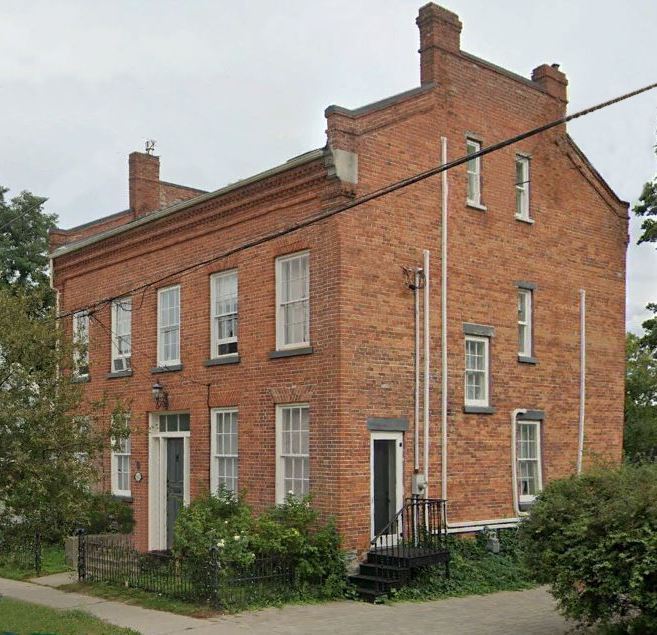
Located at 187 Walton Street and operating c1857, it is currently known as the Albion House Bed & Breakfast. It was built in 1859 on the site of an earlier coaching house. By the 1870s, the Albion, Under the proprietorship of J.H. Hawkins, was advertising 'Finest Liquors, Best Cigars, and Attentive Ostlers' on its front windows.
By the 1890s, it had changed to a temperance hotel and in the 20th century, after being reduced to a boarding house, it was divided into two semi-detached dwellings. Restored to a single house, it became a bed and breakfast in 1985.
Allen's Tavern

James Allen [1790-1861/2], an Irishman, first appears with his wife Mary in the 1822 Hope Township census. In 1829, he bought 50 acres of the north part of lot 11, concession 2 from Barnabas McKyes. The 1848 Township census report lists him as an innkeeper; the present building was likely the inn.
The land records show a Crown grant of 100 acres of the north half of lot 12, concession 2 to Allen in 1846. The house shown at right, across from the present church building on highway 2, was built that year as evidenced in the date on the front eaves.
According to Harold Reeves, Allen operated his tavern from about 1837, and the 1851 census shows Allen and family living in a one-story frame house which included a tavern. Reeves also claimed that the tavern was taken over by Crummer [Thomas?] and then by Carson [William?].

William Monaghan [1804-1874] bought Allen's interests in lot 11 and lot 12 in 1856. Monaghan was likely renting before that as he was listed as an innkeeper in the 1851 census. In March of 1855, he was offering to sub-rent the tavern, now called the Three-Mile House. It may be that Reeves was correct in his claim that Monaghan owned the property but rented it out to the latter above-mentioned innkeepers at some point.
Monaghan sold the property to James Walker in 1863.
Blackham's Saloon
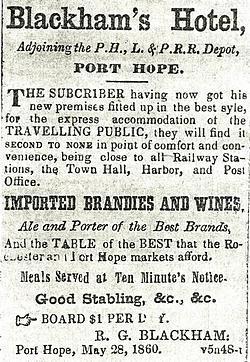
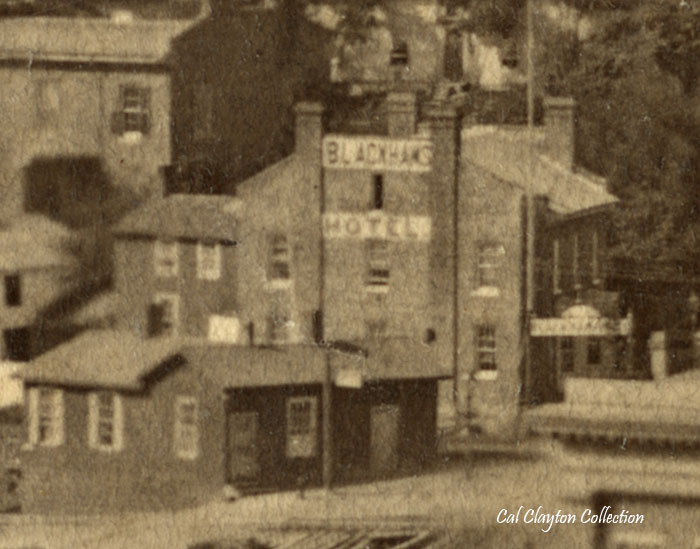
Run by Richard G. Blackham [1834-1866], it was located on John Street (possibly #85) in 1856. In 1859, he relocated to his "new and commodious premises" on the south side of Robertson Street. On the 1874 map of Port Hope, this hotel was referred to as Martin's Hotel. In the 1886, it was known as the Rochester House, Richard Guy Blackham Jr. [b1855], proprietor.
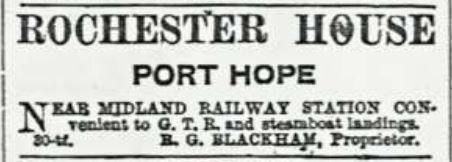
Port Hope Times: 21 January 1886
British Hotel

This c1845 hotel, located on Queen Street adjacent to the present Capitol Theatre, is believed to have originally been called the Farmers’ Depot (1856) and Farmers’ Hotel (1858), run by innkeeper John Foster [1819-1867].
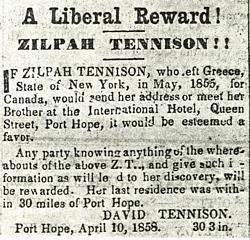
William MacDonald and/or David Tennison operated it as the International Hotel (1858) and Thomas Little (1859).
To complicate matters, the 1869-'70 Durham directory lists Farmer's Hotel, John Pollock, proprietor, on Cavan Street, and Foster's Hotel, Richard Foster, proprietor (a relative of John, after his death?), on Queen Street - presumably the future British Hotel.
John Foster’s widow, Ellen, sold it to John Gibson in 1871, who operated it for a few years as Gibson’s Tavern. After being shut down in 1874 by the Chief of Police for allowing a rowdy public house, his licence was not renewed. Gibson died 24 May 1878 at the age of 55 after choking on a piece of meat during dinner at Lee's Hotel.
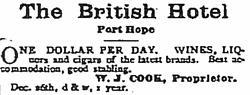
The 1880 business directory has Lawrence Haw as proprietor of the British Hotel. After operation by Pitney and Oliver, a licence renewal was issued in 1901 to Isaac Gillespie [1869-1901, of typhoid fever], and to W.J. Cook by 1903.

Brodie's Hotel
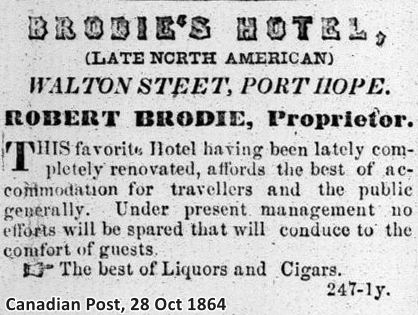
It was operated by Robert Brodie [1829-1873] and believed to have been at 26 Walton Street, where Gould's Footwear was located unti 2023.
The accompanying 1864 advertisement states that it was in the previous site of the North American Hotel, the building to the immediate west. However, based on papers and structural elements, it would appear to indeed have been Brodie's.
Canada House

Currently a B&B at the corner of King and Madison streets, it is the earliest frame hotel still in existence. Its early business history is uncertain. Built for Elias Smith c1798, local lore has it that it began its hotel life in the 1850s as the Seaman's Inn under the ownership of schooner captain Robert Wallace. By 1856, it was operating under John W. Sager [c1802-post 1861] as Canada House.
R.W. Johnson, an "old Port Hoper", stated in a 1948 letter to the paper, that Nicholas Winters [1823-1885] ran a hotel "at the foot of King Street, where Tom Burt lived later", but was uncertain as to the name.
Winters was connected with two other hotels at roughly the same time: the Queen's Arms Inn (1856) on Mill Street South (then known as "Wharf Road"); and the Victoria Hotel (1862) at Mill and Peter streets. The 1854 G.T.R. map shows an unnamed tavern on Mill Street just north of Madison, but whether or not this was Winters' is presently unknown. There were likely a number of drinking establishments, since demolished, in that area.
Ganaraska Hotel
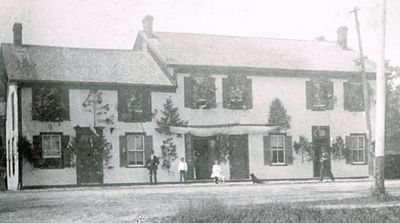 On Ontario Street, this c1837 building began its inn life in 1856 as the Railroad Hotel, William Matthews [1814-1862], owner.
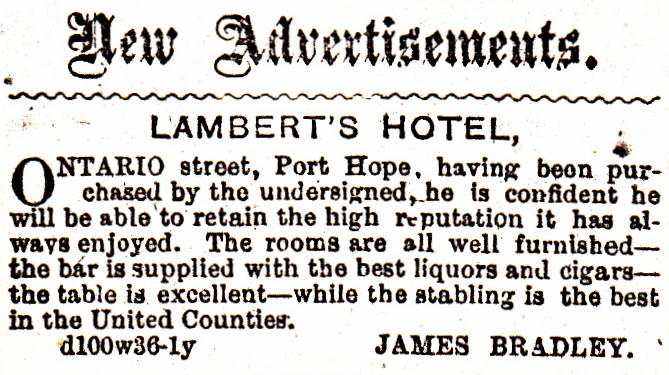
The Tri-Weekly Guide in 1859 referred to the establishment as Matthew's Hotel, also shown in the 1862 Port Hope business directory. Hugh Alexander Walker [1827-1894] owned and operated it from 1860-1864, at which point it was purchased by Charles Lambert [1813-1868], who ran it for sixteen years as Lambert's Hotel.
On Ontario Street, this c1837 building began its inn life in 1856 as the Railroad Hotel, William Matthews [1814-1862], owner.
The Tri-Weekly Guide in 1859 referred to the establishment as Matthew's Hotel, also shown in the 1862 Port Hope business directory. Hugh Alexander Walker [1827-1894] owned and operated it from 1860-1864, at which point it was purchased by Charles Lambert [1813-1868], who ran it for sixteen years as Lambert's Hotel.
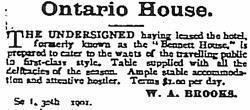
It was bought in 1880 by James Bradley [1852-1891] and, after his death in 1891, was operated by his widow, Charlotte [d1919]. There appear to have been at least three lessees between 1901-1904. Louis Gordon Bennett [1857-1940] received a licence renewal for the Bennett House in 1901. In 1901-1902, it was run under a partnership of Lena Crawford (nee Wilson) [1870-1933] and Hilliard C. Robinson [1875-1924], which dissolved, the hotel being leased the following year to Blake Crawford and William Brooks (formerly a bartender at the St. Lawrence Hotel on Walton Street) as the Ontario House. In 1904, it was sold to Margaret Howard, whose family continued to operate it under the same name for the next eighteen years.
Itheel Walter [1870-1953] leased the hotel May 1915, the inn being described as "a three-story brick structure with twenty guest rooms, centrally located within easy access to all business places."
It became the property of Samuel Palmer in 1920 and since then has gone through a succession of owners, one of whom, Stanley Crossett, changed the name to the Ganaraska Hotel in 1947. It still functions as an inn by that name today.
A history of the owners and lessees can be found here, courtesy of the current owners.
Hastings House

Credit: Mark Clayton
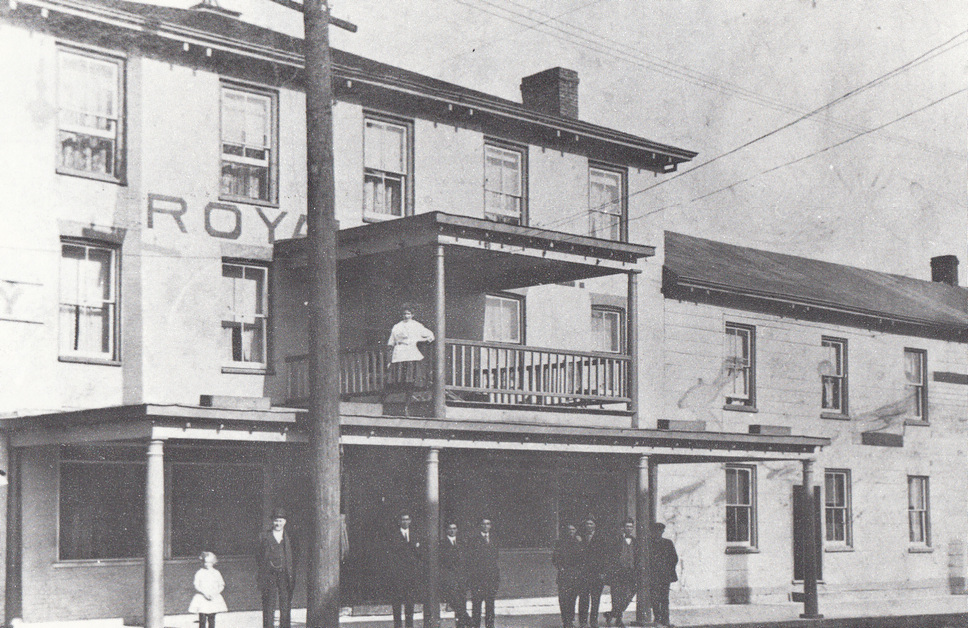
Run by Thomas Warren Hastings [1796-1885], it was the first hotel established in John Brown's building, the first brick building in Port Hope, on Mill Street at the foot of Walton. It was erected in 1823 on the presumed site of the Old Inn where, according to Guillet, stage coaches once stopped. He wrote
John Mactaggart, who was in the village in the late 'twenties, considered the inn "the best public house on all the road" and especially "for excellency in bacon, eggs, and gin."
He seems to have been more impressed by the fact that "the waiters are females, fat and plump, and wear snow-white aprons. Whenever I find females the waiters in the inns, I always find a good house."
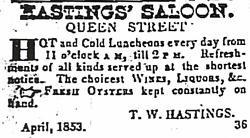
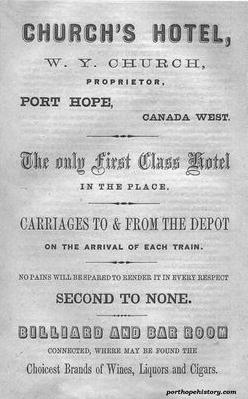
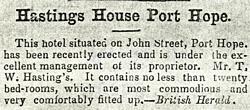
Hastings is reported to have established himself in the 1830s by catering to the town's first lobster dinner. He continued to run it under that name until relocating in 1860 to the new building, Bletcher's Tavern, erected by William Bletcher at the corner of John and Walton streets. According to an ad in the 27 November 1862 Canadian Post, Hastings renamed it Hastings' New Hotel on John Street. (He and Samuel Hastings seem to have been running the Hastings Saloon on Queen Street in 1854.)
When Hastings moved, it became Church's Hotel, operated by William Young Church [1807-1877], according to the 1862 Business Directory. In 1901, Charles R. Nixon [1842-1921] received a licence renewal for the Royal Hotel. After some years as a car dealership, it was replaced by a new hydro building, and is now the Municipal Planning Office.
Lake View House
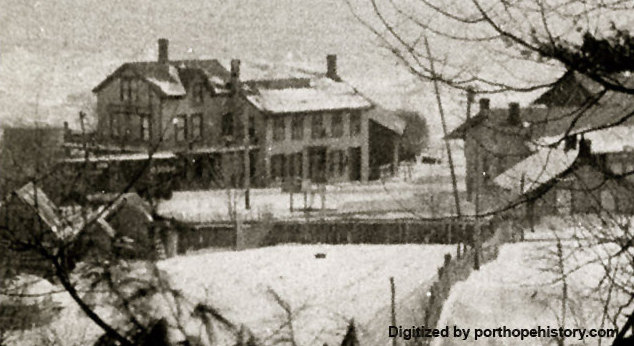 It was located opposite the Grand Trunk Railway (now CNR) station. Lovell's 1858 Directory shows that Alexander Buchanan was a saloonkeeper on Hayward Street, which would tie in with the construction of the viaduct at that time. Johnson and Holdsworth both remembered the hotel, then operated by Richard Christopher [1875-1907] who obtained a licence renewal in 1901.
Lee's Hotel
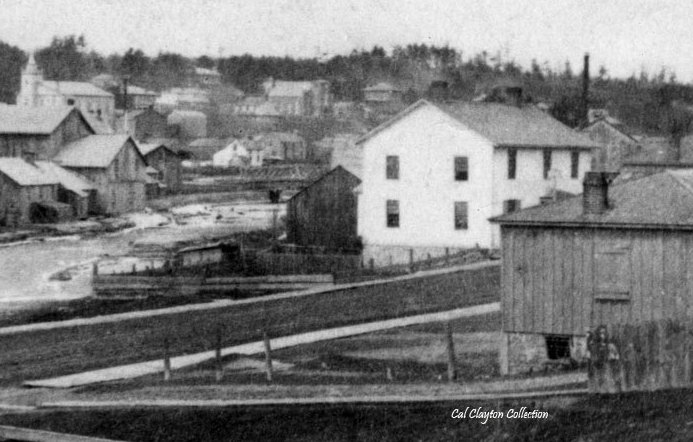 Operated by John Lee [b1837:Ireland], listed in the 1881 census as an hotel keeper, it was located on the west side of Mill Street North at the base of Ward Street.
It is claimed that Lee's was moved south on Mill Street, opposite the Rotary Bridge, and made into a double house.
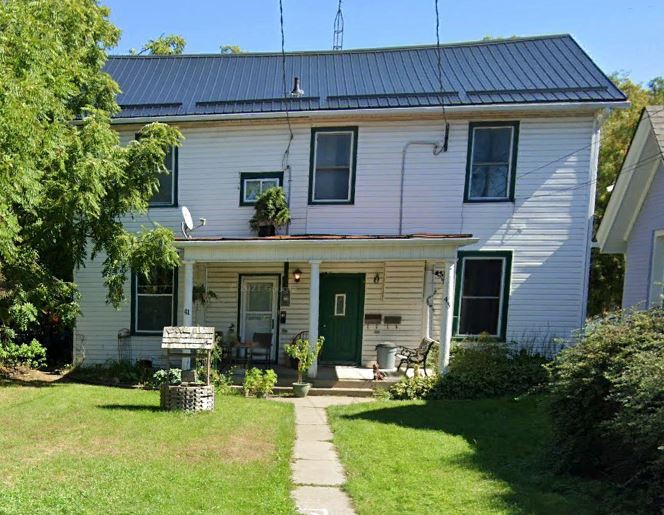
Midland House
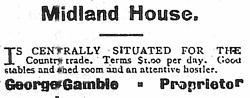
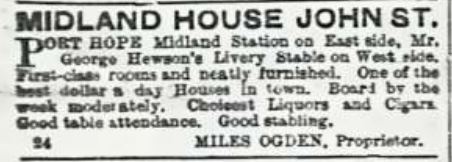 This c1850 hotel, located at 33-37 John Street, was named the Midland Hotel after the Midland, Lindsay, and Beaverton Railway, which originated in Port Hope and travelled north to those towns on Georgian Bay. Miles Ogden was proprietor in 1886. Samuel George Emerson [1871-1905] obtained a licence renewal in 1901 and is listed in the 1902 business directory. In a 1903 advertisement, C. Gillespie and George Gamble [1853-1920] are listed as co-proprietors, but by 1910, Gamble was the sole owner. Restored in the 1980s by Alice King Sculthorpe [1925-2002], it is now an apartment and commercial venue.
North American Hotel
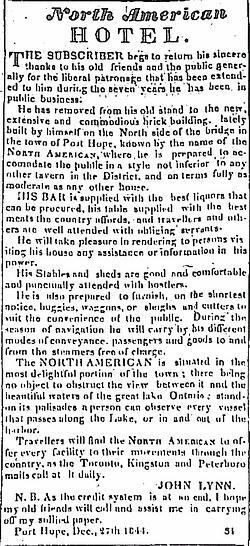
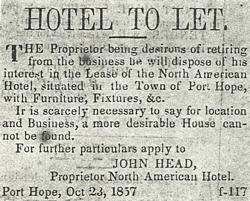
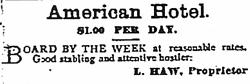
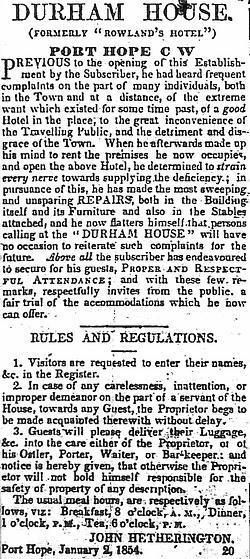
Located on Walton Street facing Queen, it had its beginnings as a hotel in 1844 when John Lynn [1799-1874] purchased the lot from John David Smith [1786-1849]. Following a disastrous fire in 1850, it was rebuilt and occupied as a hotel - T.W. Hastings' North American Hotel in 1850 - until c1911. While the 1856-1857 directory shows Robert Stenson with the hotel, Alexander Goss was connected with Stenson's Hotel on Walton Street. Proprietor John Head retired his interest in its lease in 1857. In 1858, it was taken over by John Hetherington, who had previously operated the Durham House (1856) on the site of the present Walton Hotel.
The 1862 directory shows it being operated by Hamilton Uin. An advertisement in a May 1878 Guide had John E. Lynn in charge of the American Hotel. An advertisement in the 05 January 1882 Times had S.E. Mccartney as proprietor. A licence renewal was issued to Laurance Haw [1838-1916] in 1901 and he was still operating it the following year.
Plain's Hotel
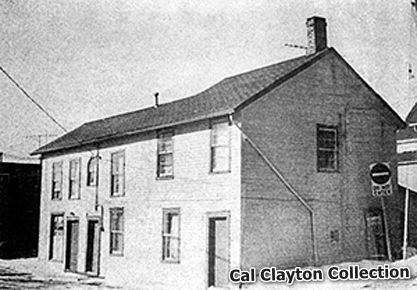 A wooden frame hotel built by Thomas Plain [1816-1899] at the corner of John and Park streets burned down and was rebuilt in 1881. The building was demolished by the town in 1980. Johnson said that Haw's & Smith's hack horses used to pull in there to quench their thirst at the trough on the way to the GTR depot.
Queen's Arms Inn
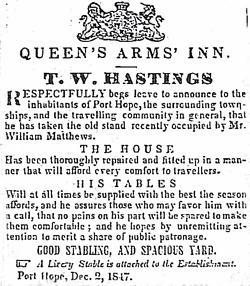 This hotel is proving to be somewhat of an enigma. William Matthews posted an ad stating his acquisition in September 1844. A December 1847 newspaper advertisement stated that T.W. Hastings [1796-1875] had "...taken the old stand recently occupied by Mr. William Matthews". In a January 1849 ad, John Reynolds of Reynolds' Hotel had "...taken the old stand known as the Queen's Arms Inn, lately occupied by T.W. Hastings" on Walton Street. On 12 October 1852, proprietor George Reynolds identified the location as "...on Mill Street, next door to Mr. S. Hatton's Store." [Samuel Hatton (1813-1865), Grocery & Liquor Store, Mill St.]. The 1856 business directory has Nicholas Winters [1823-1885] as proprietor. The inn may have been the one marked on the 1854 GTR map on the east side of Mill Street South, just north of Madison Street.
Queen's Hotel
 The Queen's Hotel site has a long-reported history of drinking establishments. Craick claimed that Joseph Caldwell [1764-1830] was the first to establish an inn on this site in 1802, the Caldwell House. In 1807, Jacob Choate [1776-1841] ran it as Choate's Inn. A frame building was the home of the Coffee Exchange House and then Thomson's Hotel, where the Board of Police first held their meetings.
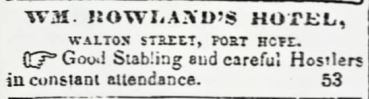
William Rowland's Hotel withstood the 1849-1850 fires and was in operation in 1851 and for sale the same year. The old wooden Durham House/Heatherington's Hotel was run by John Hetherington in the 1850s before being gutted by fire in 1859. By 1861, William Bletcher had rebuilt in brick and leased to Thomas Hastings [1796-1875], who ran the Prince of Wales' Hotel for a brief period in 1860, likely to honour the visit of the Prince of Wales that year, renaming it the Hastings House the following year.
In 1871, the present building was erected by James Cochrane and occupied by George Mackie's [d1902] Mackie's Hotel. A newspaper advertisement that same year had Robert Brodie as proprietor of the Queen's Hotel. In 1878, it was operated by Col. Allan A. Adams [1849-1909] under the same name. The 'Blackham Hotel property' (40 rooms, 20 with bath and shower) was offered for sale by R.G. Blackham in September 1887.
Louis Bennett [1857-1940] was granted a licence renewal in 1901 and continued to run the hotel through WWI. The 24 June 1921 Weekly Guide had an article in which then-current owners, Keeler & Hopkins, were transferring the business to William Bennett. In the late 1900s, owner Leo Powell renamed it The Walton, its present name. It is currently undergoing complete renovation to regain its former glory, but as condominiums and commercial space.
Red Tavern
The town's first inn was reported to have been built in 1803 by blacksmith James Hawkins [1759-1841] along the west side of Brewery Lane to the rear of the present Bell Telephone offices west of the Porter Block.
From Biographies of Early Settlers
James "Uncle Jim" Hawkins arrived in Port Hope in 1801 from Vermont and was one of the most useful men in the settlement: blacksmith, joiner, carpenter, bricklayer, and stone mason. His first work was to finish the blacksmith shop, installing a trip hammer run by water power, the first in the province. In 1802, he built a boat, and, as soon as the ice was off the lake, brought his wife and eight children - four boya and four girls - to settle in Smith's Creek.Shortly after, he built the red house behind the St. Lawrence Hotel, manufacturing all the nails, hinges, and latches used in the building, erected the chimney, plastered the walls, and finally became landlord of the stately edifice. The Red Tavern was the first place of entertainment in Smith's Creek and the scene of many lively celebrations in the early years of settlement.
Rosebury's Tavern
This 1823 tavern was located on Walton Street at Lent's Lane where the Midland Railway tracks once were.
St. George Hotel
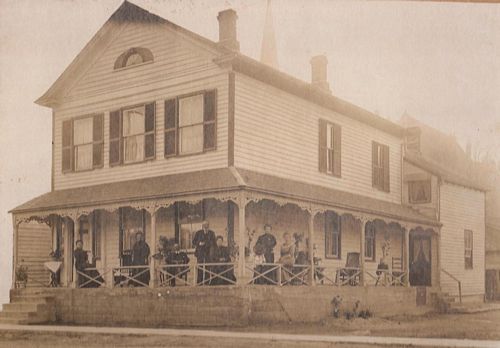
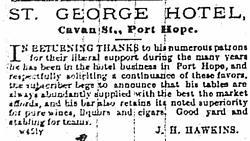
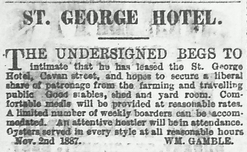
The 30 May 1878 Guide has an ad by John H. Hawkins [1819-1904]. Latterly, it was the Gamble Hotel (1889) run by William Gamble [1851-1893] who had leased it in 1887.
In the accompanying photo of 68 Cavan Street from the Michael Wladyka collection, Percy Chesterton [1898-1980] wrote on the back that this was the Minchus Hotel, later Gamble's. Two different hotels?
St. Lawrence Hall Hotel
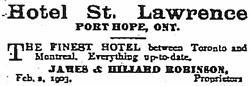 The St. Lawrence Hall Hotel block was built c1853 by Hiram Gillett with the hotel on the second floor and shops below. The owner in 1901 was Albert W. Winslow [born c1854], James and Hilliard Robinson in charge in 1903, and A.R. Schumacher in 1910. After a destructive fire 20 March 1916 (owner: W.H. Bradburn of Peterborough), it was closed for 20 years, the building going through a series of owners. It re-opened in 1936 under the ownership of Paul Haggis.
Following a major fire in 1964, Albert B. (Peter) Schultz purchased it from widow Lynn Hall 02 February 1965 and began the conversion into the present apartment complex, still with first-floor commercial use.
Smith's Tavern
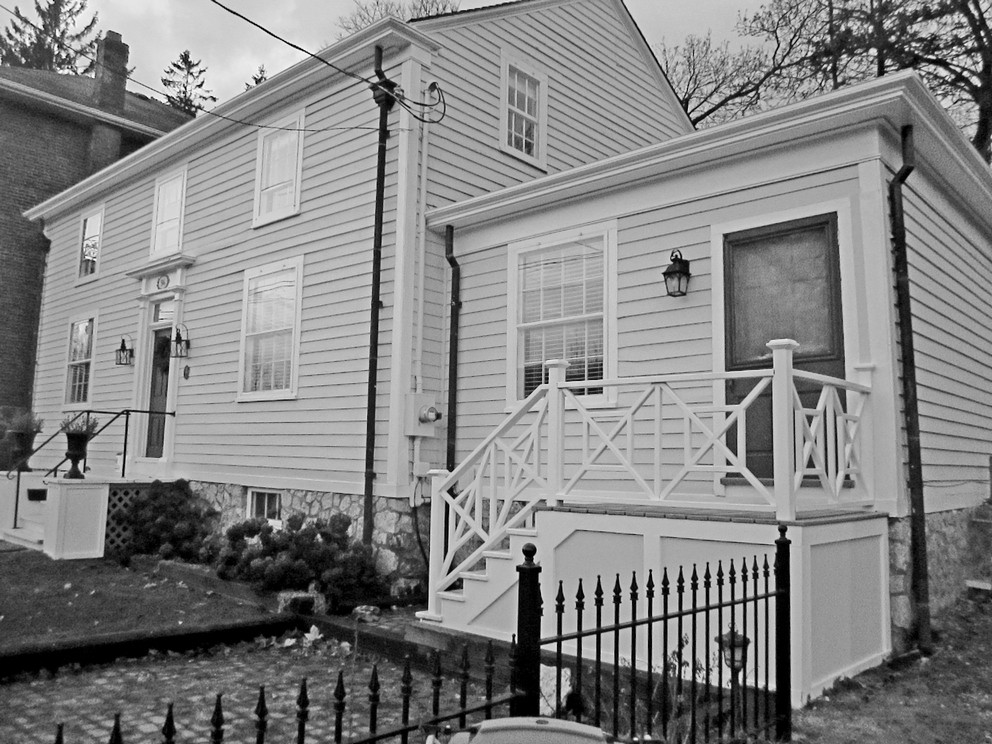 This building at 94 John Street is one of the oldest that line the south end of the street between Augusta and Dorset, having its beginnings as a local tavern, important in its location on the way to the harbour. It was constructed c1835 on the property of John David Smith [1786-1849], a son of town founder Elias Smith [1736-1820], and appears on the 1837 Bartlett print. The taproom is believed to have been the single-story addition on the north end of the house.
Source: The Heritage Port Hope Advisory Committee
Temperance Inn
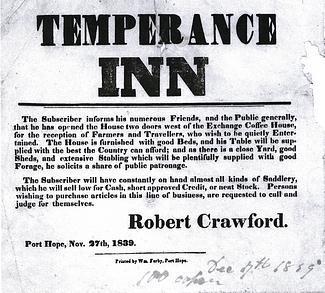 According to an 1839 flyer, it was run by Robert Crawford [1793-1871] and located two doors west of the Coffee Exchange House. The location may have been the site of the future St. Lawrence Hall Hotel.
Victoria Tavern
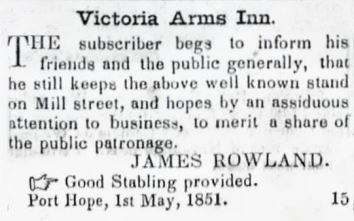
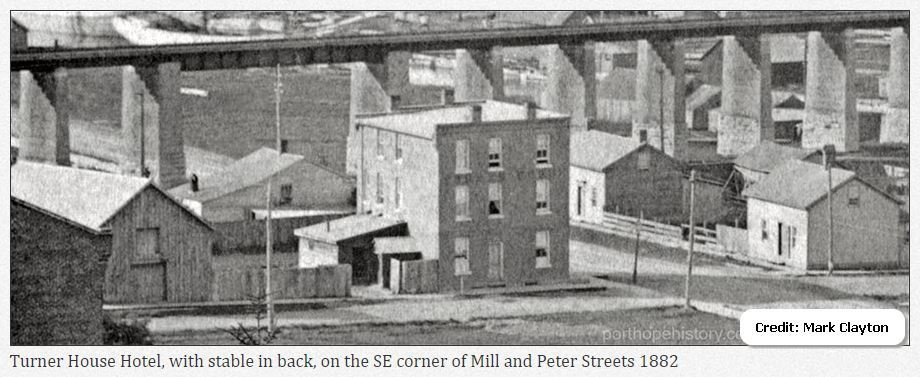 It is believed that this establishment was operating under the proprietorship of James Rowland as the Victoria Arms Inn in 1851. The GTR map of 1854 shows the Victoria Tavern on the SE corner of Mill and Peter streets. It was listed as the Ontario House under Norman Leonard Strong [1810-1897] in 1856.
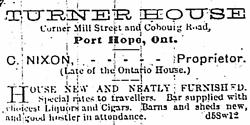
In 1857, Robert Waddell sold the property to Nicholas Winters [1823-1885], who operated it as the Victoria Hotel. In 1881, ownership of the property was transferred to John James Turner [1850-1916], who erected the present Turner House on the site. (An Evening Guide biography of Mr. Turner can be read here.) It burned and was replaced in 1882. It was up for sale in April 1882 as the Ontario House, Charles Richard Nixon [1843-1921], proprietor, and re-purchased by Turner the following year. There is no record of a licence renewal in 1901, and the property was sold to Charles Perry in 1913. It has since been restored for apartments and commercial use.
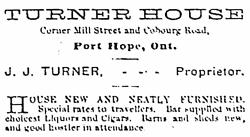
Waddell Hotel
In 1844, Robert Needham Waddell bought a parcel of land that extended from King Street to Mill Street to Walton Street from John D. Smith. In 1845, he had the present building (#1 Walton Street) constructed, designed as a hotel located in the southern section with retail space on the ground floor. Although we know that Mr. Waddell died in 1889, the history of the hotel is uncertain. However, through the efforts of the Rumgays, it is a hotel once more.
 Back to top
The following hotels are mentioned in various sources, with little detail. Their locations are uncertain and they may have been operated on sites listed earlier.
- Commercial Hotel, J. Smith German, Prop. (1869)

- Knox's Saloon, run by 27-year-old Irish Irish immigrant, John Knox, living with his wife, Ann, and family in a three-story brick saloon (1861 census)
- Mansion House, according to the 11 September 1969 Evening Guide, was a small inn at the east side of Port Hope. In 1929 it was still standing, but used as a garage. John Tucker Williams [1789-1851] stayed there in August 1829, while the Penryn Homestead was being constructed and it was at the inn that 5,000 pounds was stolen from him. In spite of a $500 reward offered by Williams and augmented by sums from John D. Smith, David Smart, William Ouston, Charles Fothergill, G.B. Boswell, Erasmus Fouke, T. Ward, and M.F. Whitehead, it was never recovered.
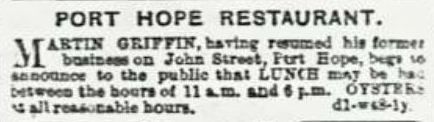
- Martin Griffin's Hotel, where Johnson reported that "no man was ever allowed a glass too much." An 1879 advertisement for the Port Hope Restaurant on John Street included the disclaimer: "...having resumed his former business" and offering lunch from 11-6 and oysters. Martin died in 1909.
- Martin's Saloon, located on Queen Street, advertised in the 1858 Guide that there was on hand an ample supply of Cameron's Ale and it "was capable of providing an Oyster Supper of best description."
- Railroad House on Mill Street, run by F. & S. Fulcher (1856).
- Shades Saloon, listed as being operated by Robert Kelly on Walton Street (1856).

- Simpson's Saloon on John Street, owned by James Simpson (1858, 1862)
- Traveller's Inn was operated by Edwin Pickering in 1856 on Julia Street. In 1857, the innkeeper was Henry Moore.
- Western House on Walton Street, was run by Thomas Truscott (1862).
- According to the 1856 business directory, the Wellington Inn, along with a grocery store, located on Mill Street, was operated by David Gillespie [1807-1873]. Lovell's 1857 directory had him as an innkeeper on Ward Street. He is also listed as "Saloon & Baker" (aged 47) in the 1861 Port Hope census.
Back to top
 Newspaper advertisements, census returns and business directories (1856-'57, 1857-'58, 1862, 1869-'70, & 1902) also list the following operators:
- Joseph Bletcher and his brother, stage proprietors and livery-stable keepers on Walton Street
- British American Hotel (c1860)
- Cassie's Hotel (c1869-'70)
- George Coad [1808-1893], a saloonkeeper on Walton Street (1858)
- J. Cochrane, saloon on Queen Street (1862)
- Walter Couchman, hotel (1902)
- Elias Crawley [1815-1898], saloon keeper (1869)
- George Donnelly, an innkeeper on Mill Street (1856)
- Ralph Francis, saloonkeeper on Queen Street (1858)
- Robert Hills, saloonkeeper on Victoria Street (1858)
- Edward Lascelles, saloon on Walton Street (1857)
- J. McCarter, saloon on Walton Street (1858)
- Donald McLean, saloonkeeper on Elias Street (1858)
- J.S. Reynolds, saloon on John Street (1862)
- H.C. Robinson [likely Hilliard Cameron: [1874-1924], hotel (1902)
- Norman Strong, innkeeper on Margaret Street (1858)
- Francis Tyler, saloonkeeper on John Street (1858)
- Isaac Weldren, innkeeper on Mill Street (1858)
- T. Whittleton [1838-1902] & Son, hotel (1902)
Back to top
Sources
- Bygone Days of East Durham. Belleville, Ontario: Richard Ellis Printing, 1981.
- Cal Clayton Collection
- Canada Directory for 1857-58. Montreal: John Lovell, 1858.
- County of Durham Directory for 1869-'70
- Guillet, Edwin C. Pioneer Inns & Taverns (Vols. 3 & 4). Toronto: Ontario Publishing Co. Limited, 1958.
- Hope and its Port. Lindsay, Ontario; Blewett Printing, 1992.
- Cal Clayton Collection
- Land Registry Records (Port Hope Archives)
- Local historians Norm Strong, R.W. Johnston, Leo "Bucky" Holdsworth, & W.A. Murray (of Rochester)
- Map of the GTR of Canada: Sheet No. 6, showing Hope Township Portion (1854)
- Michael Wladyka Collection
- Montagnes, Ian. Port Hope: A History. Port Hope: Ganaraska Press, 2007
- Port Hope Business Directory. Port Hope: Steele & Gladman, 1856-1857
- Port Hope Commercial Advertiser: 24 Jun 1848; 10 Mar 1849
- Port Hope Evening Guide: 16 Oct 1852; 04 Mar 1854; 05 Mar 1854; 26 Feb 1859; 14 May 1859; 16 Oct 1859; 15 Dec 1860; 13 Jul 1861; 03 Mar 1882; 12 May 1882; 21 Dec 1910; 13 Jul 1958; 13 Nov 1958; 11 Sep 1969; 10 Mar 1978; 03 Apr 1978; 05 Jun 1981; 15 Jul 1981; 25 May 2001; 21 Mar 2003
- Port Hope Hotels & Inns - Gazetteer & Directory (1869)
- Port Hope Weekly Guide & News: 27 Feb 1858; 10 Oct 1883; 15 May 1903
- Reeve, Harold. The History of the Township of Hope. Cobourg, Ontario: Sentinel-Star, 1967.
- Smith, William H. Smith's Canadian Gazetteer. Toronto: H. & W. Rowsell, 1846 (reprint by Coles Canadiana Collection)
- Staunton, Jane, Karen Ingram, & Lynn M. Flatley. Port Hope Architectural & Historical Inventory. Port Hope: L.A.C.A.C. 1981.
- alivingpast.ca
- Ancestry.ca
- Cemsearch.ca
- heritageporthope.com
- porthopehistory.com
Peter and Barbara Bolton - Port Hope, Ontario
alivingpast.ca